Scheduling keeps showing up in my work. A ground station schedules contacts. A CubeSat schedules payload operations. A UAV swarm schedules tasks, battery, communication, and coverage. The domain changes, but the shape stays familiar: many possible actions, limited resources, and a cost for choosing badly.
I built a tiny swarm scheduler to compare a greedy assignment with an exhaustive optimum. The point was not to build a drone planner. It was to keep the resource accounting visible.
The script is in:
res/swarm_scheduler_demo.py
I ran it with:
MPLCONFIGDIR=/tmp/mplconfig \
conda run -n exohunter python res/swarm_scheduler_demo.py \
  --plot uploads/2026/06/swarm-scheduler.png \
  --json /tmp/swarm-scheduler.json
The toy mission
The mission has three UAVs and six inspection targets. Each target has a location, reward, and service time. Each vehicle starts at the same base and has a battery budget in minutes.
Travel time is just distance divided by speed:
def travel(a, b, speed=180.0):
    return float(np.linalg.norm(a - b) / speed)
The route cost is travel plus service:
def route_cost(vehicle, route):
    pos = VEHICLES[vehicle]["start"]
    cost = 0.0
    for task in route:
        cost += travel(pos, task["xy"]) + task["service"]
        pos = task["xy"]
    return cost
This is small enough that I can solve it by exhaustive assignment. That gives me a reference for the greedy result.
Greedy versus optimal
The greedy rule takes the task with the best reward per added minute that still fits. The exhaustive solver tries every assignment to uav-1, uav-2, uav-3, or skip.
In this particular run, greedy reached the same reward as the optimum, but with a different route distribution:
{
  "greedy": {
    "reward": 100,
    "tasks": 6,
    "routes": {
      "uav-1": ["antenna", "dish", "gate"],
      "uav-2": ["tower"],
      "uav-3": ["solar", "roof"]
    }
  },
  "optimal": {
    "reward": 100,
    "tasks": 6,
    "routes": {
      "uav-1": ["antenna", "roof", "solar"],
      "uav-2": ["tower", "gate"],
      "uav-3": ["dish"]
    }
  },
  "greedy_fraction_of_optimal": 1.0
}
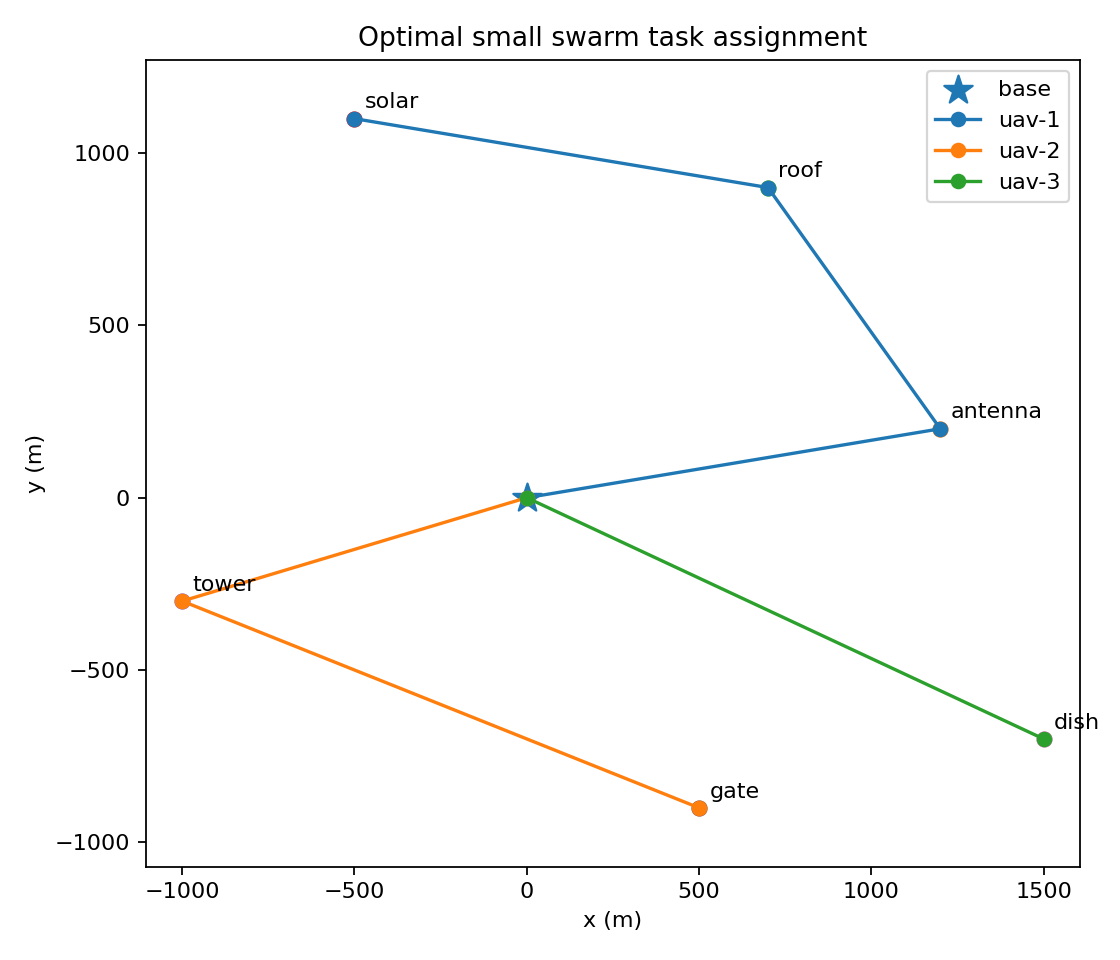
The tie is still useful. It tells me the greedy baseline is not embarrassing on this small case. If I bring an LLM agent or a more complex planner into the loop, it has to justify itself against this kind of simple baseline.
The CubeSat mapping
The same structure maps cleanly to CubeSat operations:
UAV battery       -> spacecraft energy budget
inspection target -> payload operation
travel time       -> slew, mode change, or downlink time
task reward       -> science priority
base station      -> ground contact window
The exact physics changes, but the operational question stays the same: which actions fit inside the available resources?
Where an agent fits
The solver handles clean constraints. An agent can be useful when the input includes soft instructions:
keep one UAV in reserve
inspect the antenna before the roof
avoid the vehicle with a flaky battery
prefer a payload task before the next ground pass
But the validator still owns the hard rules. A plan that exceeds battery or double-books a resource is not a clever plan. It is infeasible.
For me the architecture remains:
greedy baseline
exact solver for small/reference cases
agent for soft preferences
validator for hard constraints
human for authority
That is the same pattern I keep finding in ground-station scheduling and spacecraft operations.