The Nancy Grace Roman Space Telescope is usually discussed in terms of what it may find. I keep thinking about a less glamorous consequence: Roman-scale astronomy will stress the pipelines.
When a survey becomes large enough, the hard problem is not only detection. It is bookkeeping, false positives, cross-matching, vetting, provenance, and making sure the same event can be understood six months later.
I made a small transit-vetting simulation to keep that concrete.
The script is in:
res/roman_pipeline_demo.py
I ran it with:
MPLCONFIGDIR=/tmp/mplconfig \
conda run -n exohunter python res/roman_pipeline_demo.py \
  --plot uploads/2026/03/roman-pipeline.png \
  --json /tmp/roman-pipeline.json
A synthetic candidate
The light curve has stellar variability, white noise, and an injected transit:
def light_curve(rng, period=7.3, depth=0.006, duration=0.18, n=6000):
    t = np.linspace(0, 60, n)
    flux = 1 + 0.002 * np.sin(2 * np.pi * t / 13.0)
    flux += rng.normal(0, 0.0015, n)
    phase = (t % period) / period
    mask = (phase < duration / period) | (phase > 1 - duration / period)
    flux[mask] -= depth
    return t, flux
This is not a Roman simulator. It is a small candidate object that lets the rest of the pipeline behave like a real pipeline.
Detection is only the first row
I used a simple box score over trial periods:
def score_period(t, f, period, duration=0.18):
    phase = (t % period) / period
    mask = phase < duration / period
    return float(np.mean(f[~mask]) - np.mean(f[mask]))
The injected period was 7.3 days. The best grid period came back as:
best period: 7.278969957081545 days
period error: 0.021030042918455116 days
box score: 0.00588619345173369
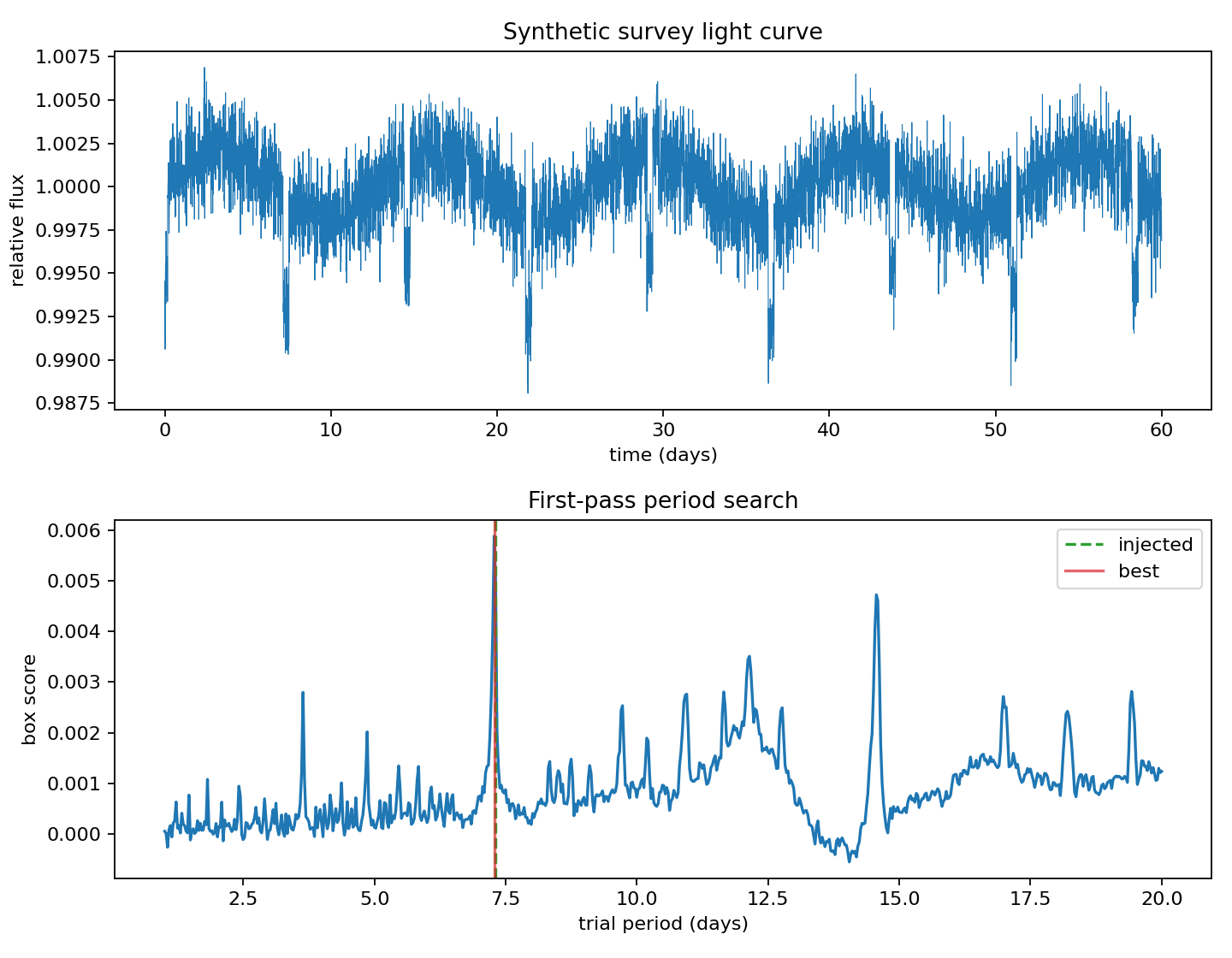
The candidate record I would keep is not only the period:
{
  "target_id": "synthetic-roman-00025",
  "injected_period_days": 7.3,
  "best_period_days": 7.278969957081545,
  "period_error_days": 0.021030042918455116,
  "best_box_score": 0.00588619345173369,
  "odd_even_delta": 0.00042,
  "centroid_shift_sigma": 0.7,
  "secondary_eclipse_score": 1.1,
  "status": "survived_first_vetting"
}
The vetting fields matter. A transit-like dip is not automatically a planet. It may be an eclipsing binary, a blend, an instrumental artifact, or a systematic that happens to fold nicely.
Why Roman changes the scale
Small surveys let humans stay close to the data. Large surveys force discipline. Every threshold, version, cross-match, failed query, and rejected candidate becomes part of the result.
That is why I think Roman will break naive exoplanet pipelines in a productive way. It will push more of the work from clever notebooks into reproducible systems.
For students, this is the main lesson: finding the dip is the start. The astronomy starts when the candidate survives the pipeline and the pipeline can explain itself.