Small UAV autonomy becomes much less romantic when the problem is “do not hit the other aircraft.” Route planning, mapping, and onboard AI are interesting, but beyond visual line of sight operations eventually hit the same hard question: what does the drone know about nearby traffic, and how early can it act?
I tested that as a small simulation. It is not a certified detect-and-avoid system. It is a timing model that makes the sensor trade visible.
The script is in:
res/detect_avoid_uav_demo.py
I ran it with:
MPLCONFIGDIR=/tmp/mplconfig \
conda run -n exohunter python res/detect_avoid_uav_demo.py \
  --plot uploads/2026/03/uav-detect-avoid.png \
  --json /tmp/uav-detect-avoid.json
The encounter
The setup has one UAV and one intruder aircraft in a two-dimensional encounter. Each vehicle is a point with position and velocity. At every second I compute distance and closest point of approach:
def cpa(own_xy, own_v, intr_xy, intr_v):
    r = intr_xy - own_xy
    v = intr_v - own_v
    vv = float(np.dot(v, v))
    if vv == 0:
        return 0.0, float(np.linalg.norm(r))
    t = max(0.0, -float(np.dot(r, v)) / vv)
    d = float(np.linalg.norm(r + v * t))
    return t, d
I compared three cases:
adsb   cooperative state is available immediately
camera target is detected only below range/FOV limits
fused  cooperative state plus the same avoidance policy
The avoidance maneuver is deliberately simple: if the predicted closest approach is inside the risk envelope, rotate the UAV velocity vector by 28 degrees. This is not flight software. It is a controlled way to compare detection timing.
What happened
The raw geometry predicted a closest approach of about 152 m if nothing changed. The runs produced:
{
  "adsb": {
    "detected_s": 0.0,
    "avoided_s": 0.0,
    "min_distance_m": 598.7464219208974
  },
  "camera": {
    "detected_s": 20.0,
    "avoided_s": 20.0,
    "min_distance_m": 332.0382006912544
  },
  "fused": {
    "detected_s": 0.0,
    "avoided_s": 0.0,
    "min_distance_m": 598.7464219208974
  }
}
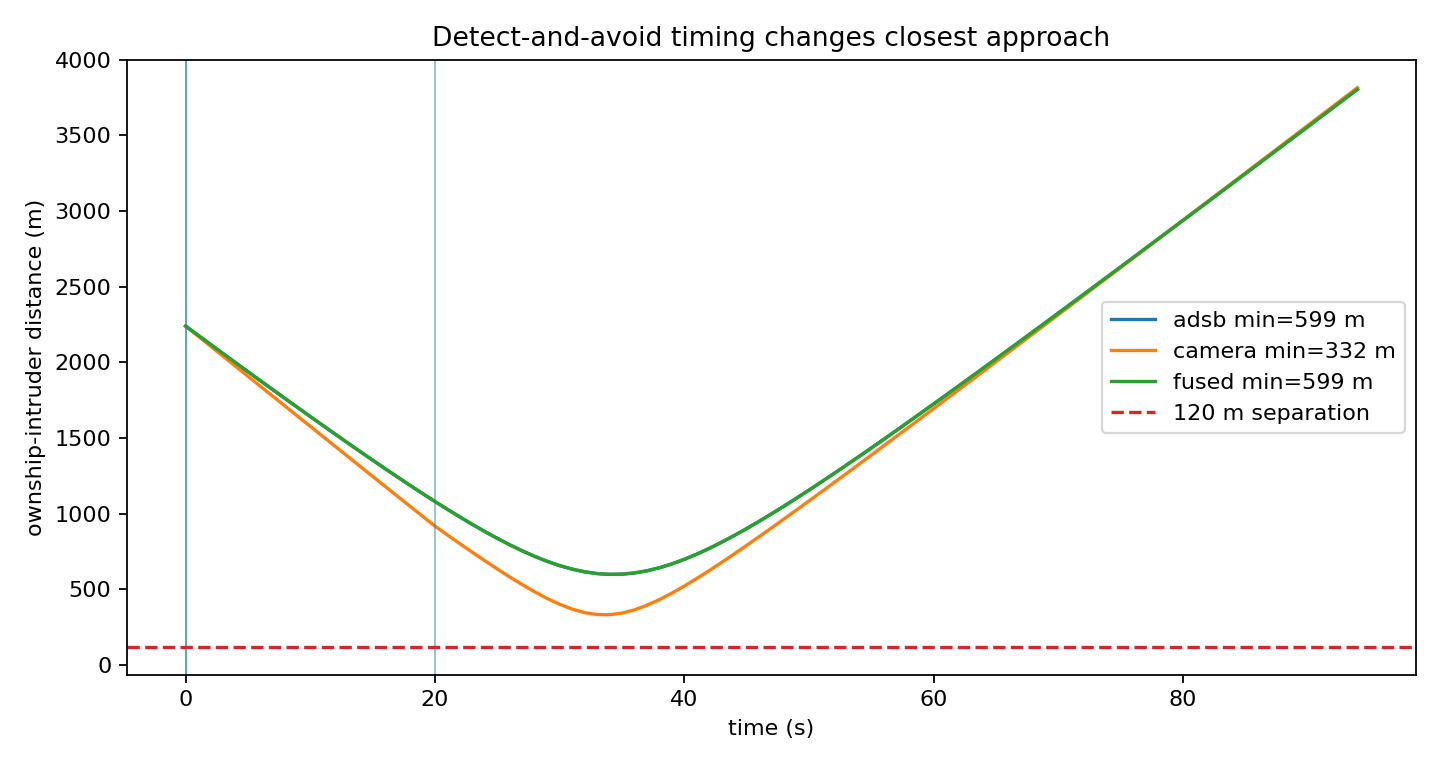
The result is not surprising, but it is useful. ADS-B-like cooperative awareness gives the ownship enough time to turn early. The camera-only case sees the intruder later, so the same avoidance rule leaves much less margin.
The ugly middle
ADS-B gives structured state, but only for cooperative targets. A camera can see non-cooperative traffic, but it gives less direct information and arrives later in this geometry. Radar helps, but costs power, mass, money, and integration time. Acoustic sensing can be attractive for small drones, but wind and local noise make it fragile.
The practical lesson is that detect-and-avoid is not one sensor. It is an uncertainty-management problem. The avionics layer needs to know when the picture is incomplete and when late detection forces conservative behavior.
What this is not
This is not a BVLOS certification model, not a 3D airspace simulator, and not an aircraft dynamics model. I ignored wind, climb/descent, sensor false positives, tracker uncertainty, pilot intent, and regulatory separation minima.
It is a small geometry test. For teaching and early design, that is enough to show why “just add a camera” is not an answer. The timing of detection matters as much as the detector itself.